
To Convert or Not to Convert: The Great Roth IRA Debate
If you’ve been stashing money away in a Traditional IRA, you’ve likely enjoyed the upfront tax deduction. But as your balance grows, so does a looming reality: every dollar, even gains, that you withdraw in retirement will be taxed.
Enter the Roth IRA conversion: a strategic move which allows you to pay taxes on that money now so it can grow and be withdrawn tax-free later.
Here’s why someone would consider a Roth Conversion (The Benefits)
Converting your Traditional IRA to a Roth IRA can offer massive long-term advantages, particularly if you expect your taxes to be higher in the future.
Tax-Free Growth and Withdrawals: Once your money is in a Roth IRA, it grows tax-free. When you pull it out in retirement (assuming you follow the rules), you won't owe a dime to the IRS.
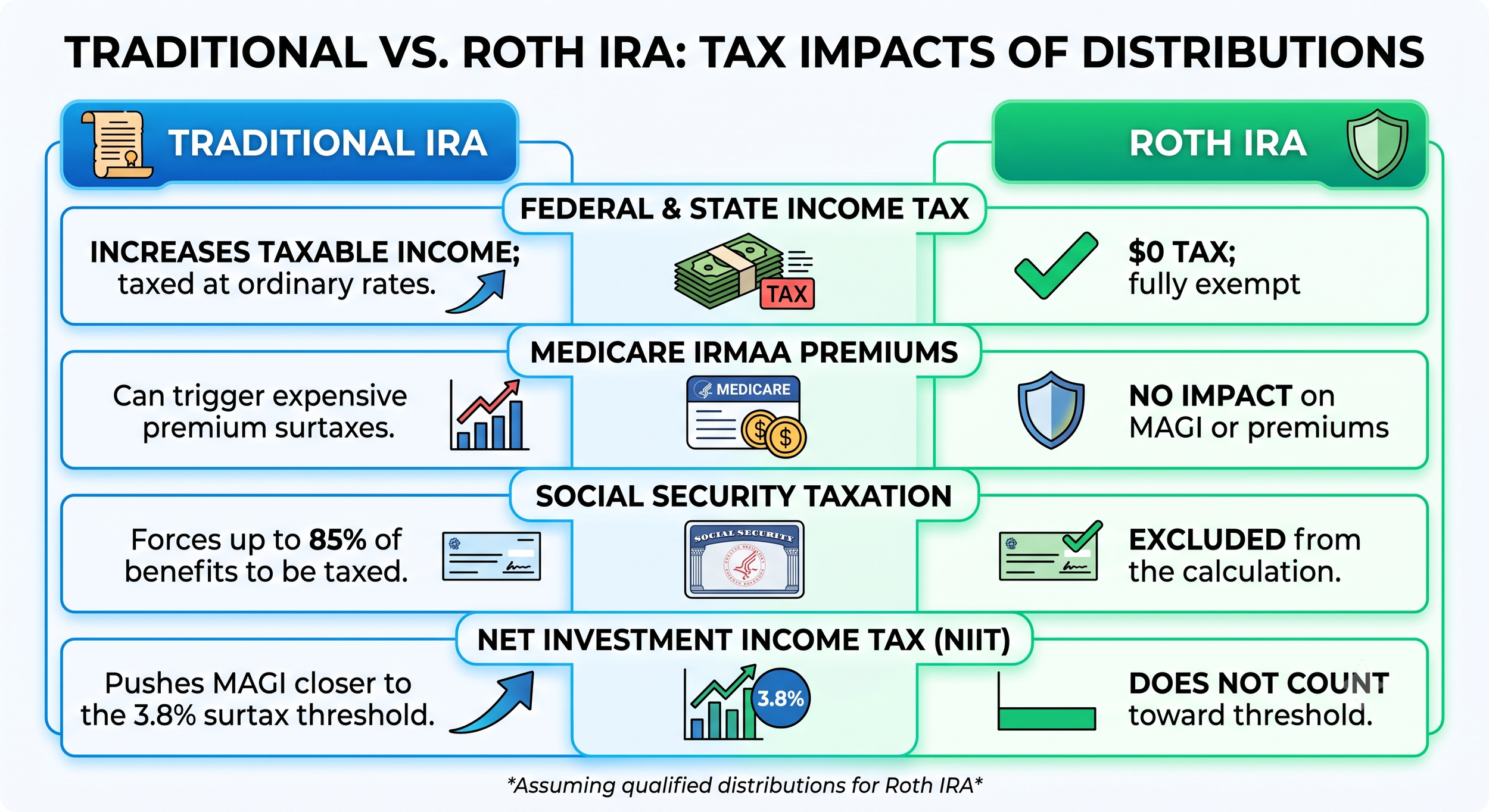
Traditional IRA distributions are taxable and can increase Social Security, Medicare, and tax on your other investment income
No Required Minimum Distributions (RMDs): Roth IRAs have no RMDs during your lifetime.
Traditional IRAs force you to start taking withdrawals (and paying taxes on them) at age 73.
A Tax-Free Legacy: As a beneficiary, a Roth IRA is one of the best accounts to receive. Beneficiaries inherit the account tax-free and can leave it that way for 10 years before tax free distributions begin.
Inherited traditional IRA’s need to be fully distributed in 10 years, with the whole balance taxed as income.
Hedging Against Future Tax Rates: If you believe federal income tax rates are likely to increase, converting now allows you to lock in at today's historically lower rates.
Here’s why you may not want to do a Roth Conversion (The Cost)
While the benefits are enticing, a Roth conversion comes with an immediate tax bill that needs to be carefully planned:
An Upfront Tax Bill: The amount you convert is added to your taxable income for the year. If you convert $50,000, you will owe income taxes on that additional $50,000.
Tax Brackets Matter: Marginal Tax Rates Escalate Quickly: A large conversion could easily bump you into a higher marginal tax bracket, increasing what you owe on converted dollars.
Mind the IRMAA- Medicare Premiums might increase: If you are on Medicare, the extra income from a conversion could put you into a new Medicare income bracket. When triggered, it can temporarily increase your monthly premiums.
Best to do it early- The 5-Year Rule: You must wait five years after your first Roth conversion before you can withdraw the converted funds penalty-free (even if you are over age 59½).
Have Outside Cash Ready- Tax Withholding reduces the benefit: The math usually only works if you pay the conversion tax bill with outside funds (like cash from a savings account). If you have to withhold taxes from the IRA itself to pay the tax, you can lose a lot of that growth potential.
The math strongly favors converting if your current tax rate is lower than your expected future tax rate and you can pay the tax bill with cash. Avoiding RMD’s and surtaxes in retirement is icing on the cake.
A Roth conversion is usually a good idea if:
You are currently in a lower tax bracket (e.g. You’re in a low-income year due to job change or early retirement).
You have years, or decades, for the money to grow before you need it.
You have cash on hand to pay the tax bill.
You are concerned about future tax rates or RMDs.
A Roth conversion is usually a bad idea if:
You are currently in your peak income years and a significant bracket.
You expect your income (and tax rate) to be significantly lower in retirement.
You will need the money in the next five years (disqualifying the tax free distributions).
You have to drain the IRA to pay the tax bill.
It’s not an all-or-nothing proposition. We have several clients who are converting just enough to fill up their 12 or 22% Federal income tax bracket annually. These "partial conversions" do add up over time and give them an additional tax-free account to consider down the road.